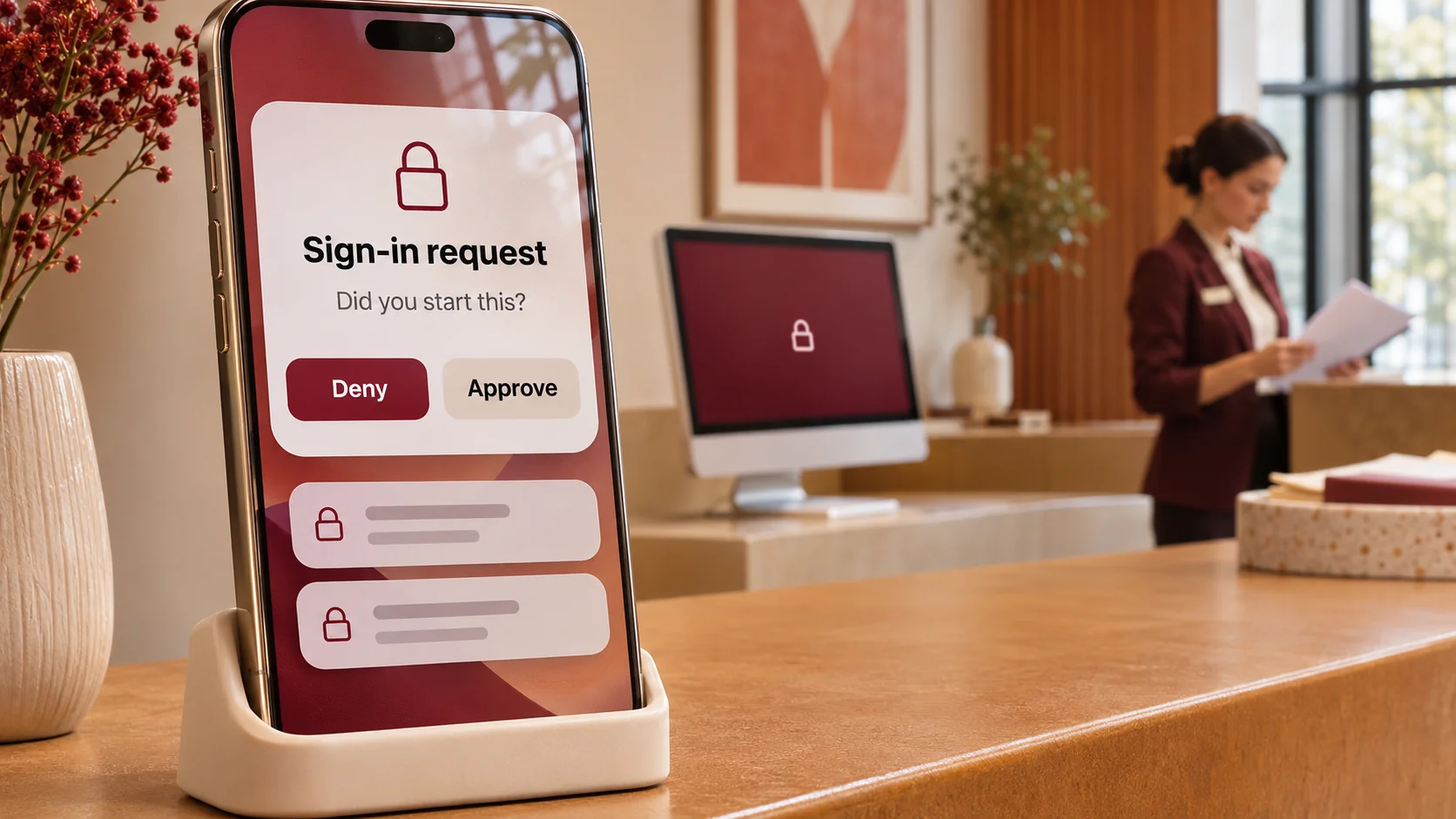
Imagine your accounts manager is checking a delivery when their phone asks them to approve a work sign-in. They dismiss it. Another request arrives, then another. A caller claiming to be IT says approving one will stop the problem.
This hypothetical situation illustrates MFA fatigue: repeated authentication requests pressure someone into authorising a login they did not start. The management question is not simply whether multi-factor authentication is switched on. It is whether your sign-in design, monitoring and response can withstand an unexpected approval request.
The request is genuine. The person signing in may not be.
In a conventional password-plus-push flow, the identity service checks the password, then sends an approval request to the registered authenticator app. If an attacker already knows that password, they may trigger the same legitimate notification. Pressing Approve can complete their sign-in, not yours.
The phone does not need to be infected for this attack to work. The weakness is a genuine approval being attached to the wrong person’s login attempt. CISA describes repeated prompts as push bombing. Western Australia’s Cyber Security Unit also advises investigating denied requests because, in this flow, the first factor may already have been satisfied.
For an Australian business, a compromised mailbox could expose customer correspondence or support convincing payment-redirection messages. Access to a cloud document service could expose contracts. These are conditional consequences, not proof that every unexpected prompt means a successful intrusion. An accidental legitimate request is also possible; logs are needed to establish what happened.
MFA fatigue needs more than a reminder to press Deny
Number matching changes the interaction. Instead of accepting a simple yes-or-no prompt, the user enters the number shown on the sign-in screen into their authenticator. Someone who did not start that sign-in should not have a number to enter.
This reduces blind approvals and makes prompt spam less useful. It is an interim improvement, not phishing-resistant authentication. A criminal may still try to relay a number or coach someone through approval. A phone call claiming to be your provider does not make an unsolicited request safe.
CISA recommends moving towards phishing-resistant MFA where supported. For decision-makers, the useful distinction is between strengthening today’s push flow and approving a longer-term migration. Do not remove existing MFA while waiting for the stronger option.
Ask IT for evidence from the actual sign-in path
Give the identity administrator ownership of configuration and investigation, with a business owner responsible for exceptions. Ask for a demonstration using a controlled test account, not a screenshot showing only that MFA is enabled.
- Method coverage: Which staff, administrator and recovery paths still allow simple approval prompts? Verify exceptions and fallback methods separately.
- Prompt controls: Where supported, limit repeated authentication requests and alert on unusual bursts or denied prompts. Test what the security team actually receives.
- Response ownership: Give staff a known reporting route and identify who can investigate promptly, including outside normal business hours.
Rate limits need care: an attacker may otherwise turn repeated requests into an account lockout that disrupts legitimate work. Test both the security benefit and the recovery process before enforcing changes widely. Do not assume every application uses the same identity policy.
Someone already approved. What should happen next?
Report the account, application and approximate time through a trusted route. IT should correlate authentication outcomes with session and application activity, preserve relevant logs, and determine whether access succeeded. Denying the next prompt does not end a session already issued.
Where compromise is suspected, contain the account using the provider’s supported controls, address exposed credentials and revoke affected sessions. Then examine what the account could access and what it actually did. Avoid promising that a password reset alone reverses disclosure or removes every form of persistence.
The business owner needs a documented outcome: what was attempted, what succeeded, what customer information may be involved and which follow-up decisions remain. A quiet phone is not the same as a completed investigation.
Make the next unexpected prompt a useful signal
Include identity configuration, monitoring and incident ownership in your managed IT security review. The aim is a sign-in process that does not rely on one busy person resisting repeated pressure, plus evidence that the response works when someone makes a mistake.
References
- WA Cyber Security Unit: Number Matching in Multifactor Authentication (2023)
- CISA: Implementing Number Matching in MFA Applications (2022)
- Canadian Centre for Cyber Security: Secure your accounts and devices with MFA (2024)
This is practical evergreen guidance, not a new incident report. Overseas government guidance informs technical decisions; it is not an Australian legal requirement.